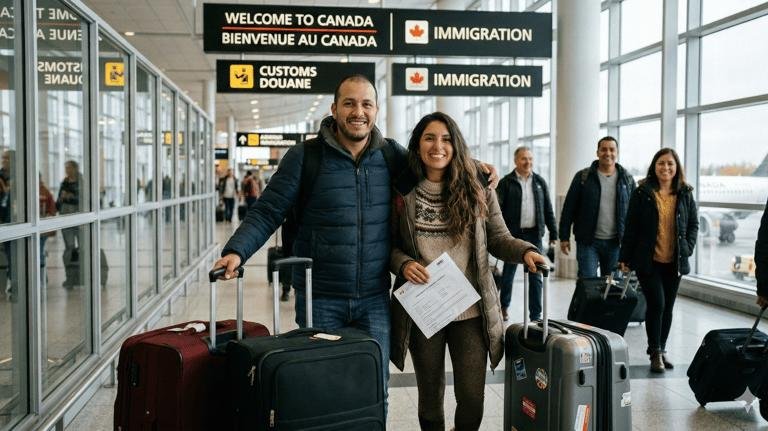
Moving from Pakistan to Canada: A Practical Checklist for Your First Month
Updated: November 2026
Moving from Pakistan to Canada involves several practical responsibilities that begin as soon as you arrive. Finding suitable accommodation, arranging identification documents, applying for a Social Insurance Number (SIN), understanding healthcare arrangements and opening a bank account are among the important tasks newcomers may need to complete.
For many Pakistani families, the first month can involve adjusting to unfamiliar weather, transportation systems, housing arrangements, workplace expectations and everyday expenses. Preparing a realistic checklist can make this transition more organised.
This guide explains the essential steps for the first 30 days in Canada. It is intended for permanent residents, international students and temporary foreign workers, although some procedures and entitlements differ according to immigration status and province.
1. Prepare Your Documents Before Leaving Pakistan
A successful first month begins before departure. Keep important documents organised and accessible rather than placing everything in checked luggage.
Essential travel and immigration documents
Depending on your immigration category, prepare:
- Valid Pakistani passport.
- Canadian visa or other required travel authorisation.
- Confirmation of Permanent Residence (COPR), if applicable.
- Study permit approval documents and letter of acceptance, if applicable.
- Work permit approval documents and employment information, if applicable.
- Proof of accommodation or temporary address.
- Travel itinerary and contact information.
- Copies of relevant immigration correspondence.
Permanent residence applicants travelling to complete their landing should carefully check their COPR and travel-document details before departure.
International students should keep their admission information and relevant study permit documentation accessible.
Workers should carry their employment and work authorisation documents where applicable.
Personal and family records
It can also be useful to carry:
- Birth certificates.
- Marriage certificate or Nikah Nama.
- NADRA Family Registration Certificate (FRC), where relevant.
- Educational certificates and transcripts.
- Professional qualifications and licences.
- Employment reference letters.
- Medical prescriptions and relevant medical records.
- Children’s school records and vaccination information.
- Driving licence and driving history, if available.
Some documents may need certified translations into English or French for use in Canada. Check the requirements of the organisation receiving each document.
Keep digital and physical copies
Maintain secure digital copies of important documents. Store them in a protected account and keep offline copies where possible.
Do not rely exclusively on a mobile phone. A printed copy of important travel and immigration documents can be useful if a device is lost, damaged or inaccessible.
2. Understand the Arrival Process at a Canadian Airport
After landing, travellers must complete the relevant immigration and customs procedures.
Permanent residence applicants arriving to complete their landing should present their passport and COPR to the Canada Border Services Agency (CBSA) officer.
The officer may:
- Verify identity and immigration documents.
- Ask questions about the intended settlement.
- Confirm relevant details from the immigration application.
- Ask about funds and goods being brought into Canada.
- Complete the permanent residence landing formalities.
If your COPR contains incorrect information, explain the issue to the officer and follow the instructions provided. Do not alter the document yourself.
Students and temporary workers
International students and workers should follow the instructions applicable to their immigration category.
Where a study permit or work permit must be issued at the port of entry, the officer may review the supporting documents before issuing it.
Check the issued document before leaving the airport. Review your name, passport information, validity dates and conditions.
If something appears incorrect, raise the issue with the officer before leaving the inspection area where possible.
3. Declare Your Money, Food and Personal Belongings
Newcomers should understand Canada’s customs declaration requirements before packing their luggage.
Declaring money
You must declare to Canadian authorities if you bring more than CAD $10,000 in currency or monetary instruments into Canada.
This does not mean that carrying more than CAD $10,000 is automatically prohibited. It means the amount must be reported as required.
The declaration rules may cover:
- Cash.
- Cheques.
- Bank drafts.
- Money orders.
- Travellers’ cheques.
- Certain securities and other monetary instruments.
Failure to declare reportable funds can result in penalties and possible seizure.
Declaring food and agricultural products
Travellers must declare food, plants and animal products when entering Canada.
This is especially important for passengers travelling from Pakistan who may be considering bringing homemade food, meat products, spices, seeds or other agricultural items.
Do not assume that an item is permitted simply because it is commonly carried in personal luggage.
Check the Canadian Food Inspection Agency and CBSA rules before packing food. If you are unsure whether an item is allowed, declare it and ask the border officer.
Bringing household belongings later
Permanent residents settling in Canada may have personal and household belongings arriving separately from their initial luggage.
Prepare an accurate list of goods being brought with you and goods arriving later. The CBSA provides the BSF186 Personal Effects Accounting Document for this purpose.
Include appropriate descriptions and values. Follow the CBSA instructions for declaring your goods when you arrive.
4. Arrange Temporary Accommodation First

Finding suitable housing is one of the most immediate challenges after arriving in Canada.
If you have not secured a long-term rental before departure, arrange temporary accommodation for the first few days or weeks.
Possible options include:
- A hotel.
- A short-term rental.
- Accommodation with relatives.
- A temporary furnished apartment.
- Student residence, if available.
- Employer-arranged accommodation, where applicable.
Temporary accommodation gives you time to inspect neighbourhoods, understand local transport and compare rental prices before signing a longer agreement.
What should you check before renting?
Before paying a deposit or signing a lease, review:
- Monthly rent.
- Utilities and additional charges.
- Lease duration.
- Security deposit rules in the province.
- Heating and electricity arrangements.
- Internet availability.
- Laundry facilities.
- Public transportation access.
- Distance from work, school or college.
- Building maintenance and safety.
Rental laws differ between provinces and territories. Check the local residential tenancy rules before signing an agreement.
Be careful of rental scams
Newcomers may be targeted by people offering attractive properties that do not exist or that they are not authorised to rent.
Warning signs include:
- Requests for money before a viewing or proper verification.
- Pressure to transfer funds immediately.
- Refusal to provide a written rental agreement.
- A landlord who cannot demonstrate authority to rent the property.
- Requests to send money through unusual payment methods.
Never send a large payment based only on photographs or social media messages. Verify the property and the person offering it.
5. Apply for Your Social Insurance Number
A Social Insurance Number is one of the most important administrative requirements for many newcomers.
A SIN is a nine-digit number used for employment, tax administration and access to certain government programs and benefits.
Permanent residents and eligible temporary residents may apply for a SIN according to their status and supporting documents.
Who needs a SIN?
You generally need a SIN to work in Canada and for relevant tax and government purposes.
For example:
- Permanent residents need a SIN when they begin working.
- International students who are authorised to work need a SIN before starting employment.
- Temporary foreign workers need a SIN to work under their authorisation.
A person who is not authorised to work should not assume that receiving a SIN grants permission to work.
How can newcomers apply?
Service Canada offers online, mail and in-person application options, depending on the applicant’s circumstances.
The documents required depend on immigration status.
For example, a permanent resident may use an accepted primary identity document such as a COPR or PR card, while a temporary resident generally needs an eligible immigration document authorising work.
Check the official SIN document requirements before applying.
Important SIN safety advice
Your SIN is confidential personal information.
Do not give it to every person who asks for it. Employers, financial institutions and government agencies may have legitimate reasons to request it, but you should understand why it is needed.
Never send your SIN through an unverified email or message.
6. Apply for Provincial or Territorial Health Insurance
Healthcare arrangements should be investigated early after arrival.
Canada’s publicly funded healthcare system is administered through provincial and territorial programs. Eligibility, coverage and waiting-period rules are not identical across the country.
Permanent residents and other eligible residents should contact the health ministry or insurance authority in their province or territory.
Why should you apply early?
Some provinces may have a waiting period before provincial health coverage begins. Others may provide coverage from an earlier date, depending on eligibility and circumstances.
Do not assume that your healthcare coverage begins automatically on the day you arrive.
What should you do?
- Identify the health insurance authority in your province.
- Check eligibility based on your immigration status.
- Prepare your passport and immigration documents.
- Provide proof of residence if required.
- Submit the application.
- Check when coverage begins.
- Arrange private insurance if there is a coverage gap or if you are not eligible for public coverage.
What about international students and temporary workers?
Their healthcare arrangements depend on the province, immigration category and, in some cases, the educational institution or employer.
Some students may be covered through a provincial program, while others may need institution-arranged or private insurance.
Temporary workers should confirm whether they qualify for provincial coverage and whether additional insurance is necessary.
Do not assume that every newcomer receives identical medical coverage.
7. Open a Canadian Bank Account
A Canadian bank account makes everyday financial activities easier.
It can be used to receive employment payments, pay rent, manage household expenses and make purchases.
Newcomers can compare accounts offered by banks, credit unions and other eligible financial institutions.
Documents that may be requested
The bank must verify your identity. Depending on its identification process, you may be asked for:
- Pakistani passport.
- Canadian immigration document.
- PR card, if available.
- Canadian address information.
- Other acceptable identity documents.
Contact the institution before visiting to confirm what it accepts for your immigration category.
A newcomer does not necessarily need to have a job or a large initial deposit to open a personal account.
Compare account charges
Before selecting an account, consider:
- Monthly account fees.
- Number of included transactions.
- ATM charges.
- International transfer costs.
- Debit card services.
- Mobile and online banking.
- Overdraft charges.
- Minimum balance conditions.
Ask for a copy of the account agreement and understand the charges before accepting the product.
Consider international money transfers
If you need to transfer funds from Pakistan, compare the exchange rate, transfer fees and delivery time.
Use regulated financial institutions or reputable authorised services. Keep records of significant transfers and their sources.
8. Arrange a Canadian Phone Number and Internet Connection
A local phone number can make daily activities easier.
Employers, landlords, schools, banks and service providers may need a Canadian contact number.
Newcomers can compare prepaid and postpaid mobile plans.
What should you compare?
- Monthly price.
- Data allowance.
- Calling and text-message limits.
- International calling charges.
- Coverage in your city.
- Contract duration.
- Roaming charges.
- Cancellation conditions.
A prepaid plan may be useful during the first few weeks because it can provide flexibility while you compare providers.
Also arrange reliable internet access for online banking, employment applications, school registration and government services.
Protect your phone and email accounts with strong passwords and two-factor authentication.
9. Learn How Public Transportation Works
Transportation arrangements differ significantly between Canadian cities.
Large cities may have buses, trains, subways, streetcars or regional rail services. Smaller communities may depend more heavily on buses and private vehicles.
First steps
- Identify the local public transportation authority.
- Download the official transit application where available.
- Check routes from your accommodation to work or school.
- Learn how to buy or reload transit passes.
- Understand service schedules.
- Check late-night and weekend services.
- Learn the nearest emergency and essential service locations.
Some cities use reloadable transit cards, while others accept contactless bank cards or mobile payments.
Should newcomers buy a car immediately?
Not necessarily.
Car ownership involves more than the purchase price. Consider insurance, registration, fuel, parking, maintenance and winter driving conditions.
If public transportation is convenient, using it initially may help you understand the city before deciding whether a vehicle is necessary.
10. Understand Your Driving Licence Requirements
Pakistani drivers moving to Canada should investigate provincial driving rules.
Driving licence exchange, foreign licence recognition and testing requirements are determined by the province or territory.
A Pakistani driving licence does not automatically give every newcomer the right to drive indefinitely in every province.
What should you prepare?
Depending on the province, useful documents may include:
- Valid Pakistani driving licence.
- Official driving history or licence verification.
- Certified translation, if required.
- Passport and immigration documents.
- Proof of provincial residence.
- Other documents requested by the licensing authority.
Some provinces may recognise driving experience from certain jurisdictions, while others may require written or practical tests.
Check the provincial licensing authority before driving.
Do not rely solely on advice from relatives or online groups because rules vary by location and immigration status.
11. Register Children for School
Families moving from Pakistan with children should contact the local school board soon after securing accommodation.
Public education is generally available without tuition fees for eligible school-age children, although eligibility and enrolment procedures are determined under provincial and territorial rules.
Documents that may be requested
- Child’s passport.
- Immigration documents.
- Birth certificate.
- Proof of residential address.
- Previous school records.
- Academic transcripts.
- Vaccination records.
- Other documents required by the school board.
English and French education
Depending on the province and family eligibility, children may attend English-language or French-language schools.
Some schools offer language support for students who are new to English or French.
Parents should contact the school board to understand placement, language assessment, enrolment dates and vaccination requirements.
Do not wait until the school term is about to begin before making enquiries.
12. Find Newcomer Settlement Services
Newcomer settlement organisations can help eligible people understand everyday life in Canada.
Services may include:
- Settlement planning.
- Employment support.
- Language assessment.
- English and French classes.
- Information about housing.
- Community orientation.
- Help understanding government services.
- Support with local referrals.
IRCC provides an online directory for finding funded newcomer services.
However, eligibility is not identical for every immigration category. Some temporary residents and international students may not qualify for the same federally funded services available to permanent residents.
Starting April 1, 2026, economic-class permanent residents are subject to a limited eligibility period for certain federally funded settlement services. Applicants should check the current eligibility information rather than relying on older settlement guides.
If you are not eligible for a particular federal service, check provincial, municipal, educational institution or community organisations for other support.
13. Start Preparing for Employment
Newcomers who intend to work should begin understanding the Canadian labour market during their first month.
A Pakistani qualification or employment history may be valuable, but Canadian employers may expect a résumé that follows local conventions.
Practical employment steps
- Prepare a clear Canadian-style résumé.
- Create or update a professional LinkedIn profile.
- Identify employers in your field.
- Review job requirements.
- Understand whether your occupation is regulated.
- Check whether your credentials need assessment.
- Obtain references from previous employers.
- Improve professional English or French communication.
Some professions, including nursing, engineering, teaching and other regulated occupations, require provincial or territorial licensing.
Do not assume that a foreign qualification automatically authorises you to practise a regulated profession.
Use legitimate employment resources
Newcomers can use official job-search resources and eligible settlement organisations.
Be cautious of recruiters who ask for money in exchange for a guaranteed job or promise an immigration status that they cannot provide.
14. Understand Basic Canadian Laws and Everyday Responsibilities
Moving to Canada also means learning local rules and expectations.
During the first month, become familiar with:
- Residential tenancy laws.
- Employment standards.
- Traffic regulations.
- Workplace safety.
- Public transportation rules.
- Waste and recycling procedures.
- Local parking regulations.
- Consumer protection.
- Emergency services.
The rules differ between provinces and municipalities.
For example, waste collection schedules and recycling requirements may vary between neighbouring cities.
Read official local guidance instead of assuming that procedures are the same throughout Canada.
Emergency number
In an emergency involving an immediate threat to life, safety or property, call 911 in Canada.
Learn the local non-emergency police number and the location of nearby hospitals, pharmacies and urgent-care services as well.
15. Understand Canadian Taxes and Government Benefits
Newcomers should understand that immigration status and tax residency are different concepts.
The Canada Revenue Agency (CRA) determines tax residency based on residential ties and the applicable tax rules.
A person may become a resident for Canadian tax purposes even though their immigration category is temporary.
What should you do?
- Keep records of your arrival date.
- Maintain documents showing relevant income.
- Record employment start dates.
- Keep bank and investment information.
- Understand the tax residency rules.
- Check whether you qualify for benefits or credits.
- Prepare for your first income tax return.
Eligible newcomers may qualify for certain benefits and credits, depending on income, family circumstances and tax residency.
The CRA explains that a tax return may be required even if you have little or no income, particularly when you want to receive or continue receiving certain benefits.
Do not assume that every newcomer automatically qualifies for every government payment.
16. Build a Realistic First-Month Budget
The first month can be more expensive than expected because several costs may arise at the same time.
Newcomers should plan for:
- Temporary accommodation.
- Rental deposit and first month’s rent, where permitted.
- Groceries.
- Local transportation.
- Mobile phone and internet.
- Winter clothing, if needed.
- Household essentials.
- School-related costs.
- Private health insurance, if needed.
- Employment-related expenses.
- Emergency savings.
Keep some money available for unexpected costs
Do not spend the entire settlement budget immediately after arrival.
Unexpected expenses may include additional accommodation nights, transportation changes, household purchases or delays in receiving employment income.
A separate emergency reserve can provide useful financial flexibility.
17. A Practical 30-Day Settlement Schedule
The following schedule is a planning guide rather than a legal deadline. Adjust it according to your immigration status, location and personal circumstances.
First 48 hours
-
Complete the required immigration and customs procedures.
-
Keep your passport and immigration documents secure.
-
Confirm your temporary accommodation.
-
Arrange a working mobile phone connection.
-
Learn the nearest essential services.
-
Check your immediate transportation options.
-
Contact family members to confirm safe arrival.
Days 3–7
-
Start your SIN application if eligible.
-
Apply for provincial or territorial health coverage if eligible.
-
Begin looking for suitable long-term accommodation.
-
Research local banking options.
-
Identify the nearest grocery stores and pharmacies.
-
Find local public transportation routes.
-
Contact a newcomer service provider if eligible.
-
Check the requirements for children’s school enrolment.
Days 8–14
-
Open a suitable Canadian bank account.
-
Review rental options and tenancy conditions.
-
Arrange appropriate private insurance if needed.
-
Organise important family and educational documents.
-
Begin preparing a Canadian-style résumé if seeking work.
-
Review local driving licence requirements.
-
Set up secure online access to important accounts.
Days 15–21
-
Follow up on outstanding government applications.
-
Complete school registration where applicable.
-
Continue employment or education arrangements.
-
Review your monthly household budget.
-
Learn local waste collection and recycling procedures.
-
Identify nearby medical and emergency facilities.
Days 22–30
-
Review your accommodation and household arrangements.
-
Confirm that essential documents have been received or applications are progressing.
-
Review your banking and recurring expenses.
-
Build a longer-term employment or education plan.
-
Understand your tax responsibilities.
-
Identify community activities and local support networks.
-
Prepare a plan for the next three months.
18. Special Considerations for Different Newcomer Categories
Not every person moving from Pakistan to Canada has the same rights or responsibilities. Your immigration status affects which tasks should receive priority.
Permanent residents
Permanent residents should pay particular attention to:
- Completing the landing process, where applicable.
- Providing a Canadian mailing address and photo for the first PR card.
- Applying for a SIN.
- Checking provincial healthcare eligibility.
- Understanding settlement services.
- Learning their rights and responsibilities as permanent residents.
Most first PR cards are issued automatically if IRCC receives the required Canadian address and photo within 180 days of becoming a permanent resident.
International students
Students should prioritise:
- Receiving and checking the study permit.
- Completing college or university registration.
- Confirming tuition and payment arrangements.
- Understanding study permit conditions.
- Checking whether they are authorised to work.
- Applying for a SIN if eligible to work.
- Confirming health insurance arrangements.
- Finding suitable accommodation near the institution.
Students should not work in a way that violates the conditions of their study permit.
Temporary foreign workers
Workers should prioritise:
- Checking the issued work permit.
- Reviewing employer and occupation details.
- Understanding work permit conditions.
- Confirming accommodation and transport to work.
- Applying for a SIN.
- Checking provincial health coverage.
- Understanding employment standards.
- Keeping copies of employment agreements and pay records.
A work permit’s conditions must be followed. A worker should not assume that they can change employers or occupations without checking the applicable rules.
19. Conclusion
Moving from Pakistan to Canada requires careful organisation, particularly during the first month. Newcomers need to understand immigration formalities, housing, SIN applications, healthcare, banking, transportation and local settlement services.
The exact process depends on whether a person arrives as a permanent resident, international student or temporary worker. Provincial and territorial rules also influence healthcare, education, driving and rental arrangements.
Rather than trying to complete everything in one day, use a practical schedule, keep your documents organised and prioritise essential tasks. Taking time to understand local systems can make the transition more manageable and help you prepare for the next stage of life in Canada.
Frequently Asked Questions
1. What should I do first after moving from Pakistan to Canada?
First, complete the required immigration and customs procedures, secure your accommodation and keep your travel documents safe. Then prioritise your SIN application, healthcare arrangements and essential banking requirements, according to your eligibility.
2. How soon should I apply for a SIN after arriving in Canada?
You should apply as soon as you need one and have the required documents. A SIN is generally needed to work and for relevant government programs and benefits. Service Canada offers online, mail and in-person application methods.
3. Do permanent residents automatically receive a Canadian PR card?
Most new permanent residents do not need to apply for their first PR card. IRCC generally sends it automatically if the required Canadian mailing address and photo are provided within 180 days of becoming a permanent resident.
4. Can Pakistani newcomers receive free healthcare immediately?
Not necessarily. Healthcare eligibility and waiting periods depend on the province or territory and the newcomer’s immigration status. Apply as soon as possible and check whether private insurance is necessary while waiting for coverage.
5. Can I open a Canadian bank account without having a job?
Generally, yes. Employment is not a universal requirement for opening a personal bank account. The bank must verify your identity and may request acceptable identification documents.
6. Should I bring Pakistani food to Canada?
You must declare food products when entering Canada. Some foods may be restricted or prohibited depending on the product and country of origin. Check current CBSA and Canadian Food Inspection Agency requirements before packing food.
7. Can I use my Pakistani driving licence in Canada?
The rules depend on the province or territory and your status. Some jurisdictions recognise foreign driving experience or provide a limited period for using a foreign licence. Check the local licensing authority before driving.
8. Are newcomer settlement services free?
Many federally funded settlement services are free for people who meet the eligibility requirements. However, not every temporary resident or international student qualifies. Check IRCC’s current eligibility rules and local alternatives.
9. Do Pakistani children need to attend a private school in Canada?
No. Eligible children can generally attend publicly funded elementary or secondary schools without tuition fees. Enrolment requirements, school placement and eligibility should be confirmed with the local school board.
10. When should I file my first Canadian tax return?
Your tax obligations depend on when you become a resident for Canadian income tax purposes and your circumstances. The CRA provides guidance for newcomers. Many newcomers need to file a return for the year they become tax residents, even if they arrived partway through the year.
Independent Information Disclaimer
NewsGlobality.com is an independent informational blog. It is not affiliated with, authorised by, or endorsed by Immigration, Refugees and Citizenship Canada (IRCC), the Canada Border Services Agency (CBSA), the Government of Canada, provincial governments or any visa application centre. This article is provided for general educational purposes and does not constitute legal, immigration, financial or professional advice. Immigration, healthcare, tax, housing and settlement rules may change and differ by province or territory. Readers should verify current requirements through official government sources and relevant service providers.
1 thought on “Moving from Pakistan to Canada: First-Month Checklist (2026)”