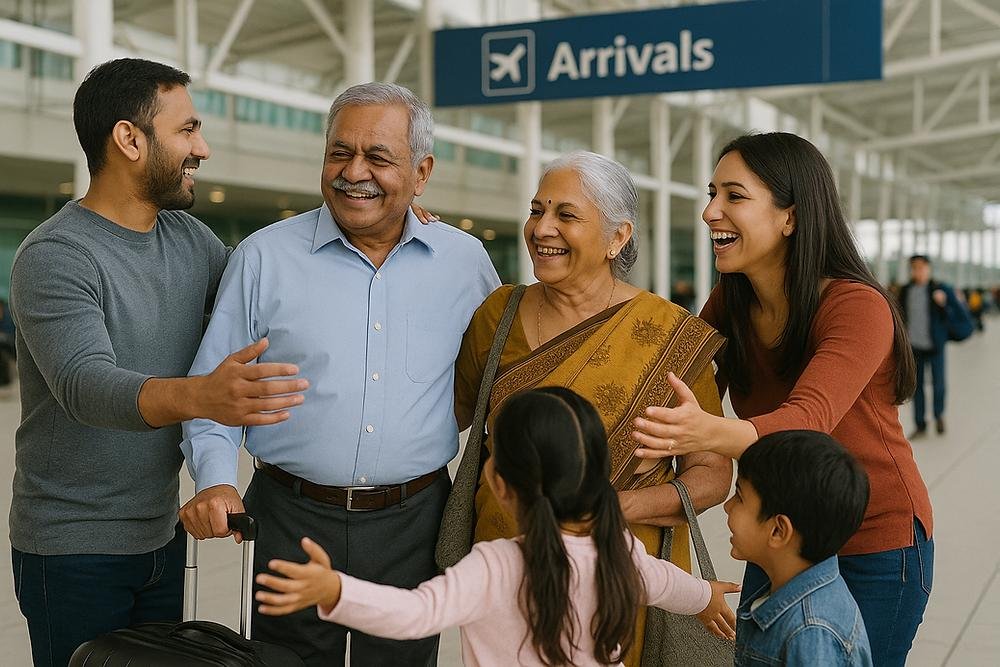
Canada Super Visa for Pakistani Parents: How to Prepare for Arrival at the Canadian Airport in 2026
Canada Super Visa arrival 2026 is an important subject for Pakistani parents and grandparents preparing to travel to Canada to visit their children or grandchildren. Receiving a Super Visa is an important achievement, but it does not mean that the traveller can ignore the entry requirements at the Canadian airport.
When a Super Visa holder arrives in Canada, a border services officer from the Canada Border Services Agency (CBSA) examines the traveller’s identity and determines whether they meet the requirements for entry. The officer may ask questions about the purpose of the visit, the Canadian host, the proposed stay and supporting documents.
Pakistani parents should therefore prepare their travel documents before leaving Pakistan. Important documents should remain in their hand luggage rather than being packed in checked baggage. They should also understand the rules concerning medical insurance, permitted length of stay, customs declarations, food products and medicines.
This guide explains what Super Visa holders should expect when arriving in Canada in 2026 and how families can prepare for the airport inspection process.
1. Does a Super Visa Guarantee Entry into Canada?
No. A valid Super Visa does not automatically guarantee entry into Canada.
A Super Visa allows an eligible parent or grandparent to travel to a Canadian port of entry and request admission. The final entry decision is made by a border services officer after examining the traveller.
The officer may verify:
- The traveller’s identity.
- The validity of the passport and Super Visa.
- The purpose of the visit.
- Whether the visitor continues to meet the applicable Super Visa requirements.
- Whether the required medical insurance is available.
- Whether the visitor appears admissible to Canada.
- Whether the visitor intends to leave Canada at the end of the authorized stay.
IRCC explains that a person may be refused entry if they provide false or incomplete information or fail to satisfy the entry requirements.
Pakistani parents should answer questions honestly and provide documents when requested.
A visa approval is an important step, but the traveller must still satisfy the requirements at the border.
2. Documents Pakistani Parents Should Carry to the Canadian Airport
One of the most important preparations is organizing travel documents before departure.
IRCC advises Super Visa holders to carry the documents used in their application. These should not be placed in checked baggage because the traveller may need to show them during the arrival process.
The following documents may be useful.
Passport and Super Visa
Carry the original passport containing the valid Super Visa counterfoil.
Check that:
- The passport belongs to the traveller.
- The passport is valid for the intended journey.
- The visa details are correct.
- The visa is valid for the planned arrival date.
- The passport has sufficient blank pages where needed.
Pakistani travellers should also check the expiry date of their passport before booking travel.
Proof of medical insurance
Super Visa holders must have qualifying medical insurance for each entry into Canada.
IRCC’s requirements include:
- Minimum emergency coverage of CAD $100,000.
- Coverage for healthcare, hospitalization and repatriation.
- Validity for at least one year from the date of entry.
- A qualifying Canadian insurance company or eligible foreign insurer.
- A policy that has been paid in full or is being paid in instalments with a deposit, as permitted by IRCC.
Carry the insurance certificate, policy information and evidence of payment.
If the policy is due to expire before the visitor leaves Canada, IRCC advises that it should be renewed to maintain coverage during the stay.
Invitation letter
Carry a copy of the invitation letter from the Canadian child or grandchild.
The letter should identify the host and explain the family relationship, accommodation arrangements and purpose of the visit.
It may also help the traveller answer questions about where they will stay and who they are visiting.
Proof of the host’s Canadian status
Carry a copy of relevant evidence showing that the host is a Canadian citizen, permanent resident or registered person under the Indian Act, as applicable.
Examples may include a citizenship certificate, Canadian passport, permanent resident document or status card.
Proof of family relationship
A copy of the relevant birth certificate or other official relationship document may help establish the relationship between the traveller and the Canadian host.
For example, a Pakistani parent may carry the child’s birth certificate identifying them as the parent.
Supporting documents from the original application
IRCC advises travellers to bring the documents used in their Super Visa application.
Depending on the case, these may include:
- Financial support documents.
- Medical examination information.
- Family relationship evidence.
- Accommodation details.
- Other supporting records submitted with the application.
Not every traveller will be asked to show every document. Nevertheless, keeping important records accessible is a sensible preparation.
3. How to Organize Documents in Hand Luggage
Pakistani parents should organize their documents in a folder or document wallet before leaving home.
A practical arrangement is to keep the documents in the following order:
- Passport with valid Super Visa.
- Medical insurance certificate.
- Insurance payment confirmation.
- Invitation letter.
- Canadian host’s status document.
- Proof of relationship with the host.
- Canadian residential address and contact number.
- Copies of relevant supporting documents.
- Prescriptions or medical records, if relevant.
- Flight itinerary and other travel information.
Keep original documents safe and avoid handing them to anyone who is not authorized to examine them.
It is also useful to keep electronic copies in a secure location, but electronic copies should not be treated as a replacement for original documents when those are required.
4. What Happens When Pakistani Parents Arrive at a Canadian Airport?
The arrival process can vary according to the airport, the traveller’s circumstances and the inspection arrangements in place.
Generally, travellers go through the following stages.
Stage 1: Arrival and identity verification
After leaving the aircraft, travellers follow airport signs for border inspection.
At major Canadian airports, travellers may use a primary inspection kiosk or other available identity-verification system.
The system may verify the traveller’s identity and collect or confirm the required information.
Stage 2: Customs and immigration declaration
Travellers must answer the relevant customs and immigration questions accurately.
They should declare goods, food, currency and other items where required.
If unsure whether an item needs to be declared, they should ask a border services officer rather than guessing.
Stage 3: Speaking with a border services officer
The officer may ask questions about the visit, the traveller’s documents and their intended stay.
The traveller should answer clearly and truthfully.
Stage 4: Additional inspection, if required
Some travellers may be referred for secondary inspection.
This does not automatically mean that they have done something wrong. An officer may need additional information, examine luggage or verify documents.
Travellers should cooperate and follow the officer’s instructions.
Stage 5: Entry decision
If the traveller satisfies the requirements, the officer may allow entry into Canada.
The officer may stamp the passport or provide other relevant documentation.
Super Visa holders should confirm the authorized period of stay before leaving the inspection area if they have questions about the date.
5. What Questions Can CBSA Officers Ask Super Visa Holders?
Border officers may ask questions to establish whether the traveller meets the requirements for admission.
The questions are not necessarily the same for every person.
Examples include:
What is the purpose of your visit?
The traveller should explain that they are visiting their child or grandchild in Canada under the Super Visa programme.
Who are you visiting?
The traveller should be able to provide the host’s name and explain the family relationship.
Where will you stay?
The traveller should know the host’s Canadian residential address.
Keeping the address and contact number in hand luggage can be helpful.
How long do you intend to stay?
The traveller should provide a truthful answer that is consistent with their travel plans and circumstances.
They should understand that the officer determines the authorized stay under the applicable rules.
Who will support your expenses?
The traveller should explain the financial arrangements accurately.
If the Canadian child or grandchild is providing accommodation and financial support, the visitor can explain that arrangement.
Do you have medical insurance?
The traveller should be ready to show the qualifying insurance policy and proof of payment.
What do you do in Pakistan?
The officer may ask about the traveller’s employment, retirement, family or other circumstances in Pakistan.
The applicant should provide accurate answers rather than memorized statements.
Do you intend to return to Pakistan?
The traveller should explain their genuine circumstances and intended departure plans.
A visitor must comply with the authorized period of stay.
6. How Long Can Super Visa Holders Stay After Arrival?
The permitted stay depends on the applicable Super Visa rules and the circumstances of the entry.
Under the rules for Super Visa applications made on or after 22 June 2023, eligible holders can generally stay in Canada for up to five years at a time.
For applications made before that date, the period may depend on the entry date and the authorization granted by the border officer.
The traveller should not assume that the expiry date printed on the visa is the date they must leave Canada.
These dates have different purposes:
- Visa expiry date: The date by which the visa may be used to travel to a Canadian port of entry, subject to its conditions.
- Authorized stay: The period the person is allowed to remain in Canada after admission.
If the officer issues a visitor record or provides a specific departure date, the traveller should follow that authorization.
If no passport stamp or separate visitor record is issued, Super Visa holders should consult the applicable five-year rule and official IRCC instructions.
7. Medical Insurance: An Important Requirement at the Border
Medical insurance is one of the most important Super Visa requirements.
A border services officer may ask to see proof that the traveller has qualifying insurance.
The policy should meet the applicable IRCC requirements, including the minimum emergency coverage amount and the required coverage period.
Before departure from Pakistan, parents should confirm:
- The correct applicant’s name appears on the policy.
- The policy meets the CAD $100,000 minimum emergency coverage requirement.
- Healthcare, hospitalization and repatriation are covered.
- The policy is valid for at least one year from entry.
- The insurance company meets IRCC’s requirements.
- The policy has been paid in full or the permitted instalment arrangement has been made.
- The certificate and payment evidence can be shown at the border.
A quotation or an unpaid insurance proposal should not be treated as proof of an active qualifying policy.
If the traveller’s policy has been cancelled, refunded or otherwise changed after visa approval, they should resolve the issue before travelling.
8. What Food Items Can Pakistani Parents Bring to Canada?
Many Pakistani families want to bring traditional food items when visiting relatives in Canada.
However, Canada has rules governing food, plant and animal products brought across the border.
Items such as meat, dairy products, fresh fruit, vegetables, seeds and plant materials may be subject to restrictions or special conditions.
The rules can depend on the product, its origin, how it is packaged and current import requirements.
Pakistani parents should not assume that an item is permitted simply because it is cooked, dried, homemade or commercially packaged.
Before packing food:
- Check the official Canadian Food Inspection Agency guidance.
- Review the rules for the specific product and country of origin.
- Declare food and agricultural products when required.
- Ask a border officer if unsure.
- Do not hide restricted items in luggage.
Failure to declare regulated items can result in penalties or seizure.
For current information, use the official Canadian government tool:
https://inspection.canada.ca/en/food-safety-consumers/bringing-food-canada-personal-use
9. Can Pakistani Parents Bring Medicines into Canada?
Travellers may need to bring prescription medicines for ongoing health conditions.
They should keep medicines in their original packaging where possible and carry a copy of the prescription or a medical document explaining the treatment.
Before travelling, check whether the medicine is permitted for import into Canada and whether special rules apply.
Important precautions include:
- Carry medicines for personal use only, within the applicable limits.
- Keep prescription information available.
- Do not carry medicines for other people without understanding the relevant rules.
- Check requirements for controlled or narcotic medicines before departure.
- Declare items when required.
Some medications that are commonly available in Pakistan may be regulated differently in Canada.
Travellers should check the official Health Canada and CBSA information rather than assuming that all medicines can be brought into the country.
10. How Much Cash Can Parents Bring to Canada?
Travellers can bring cash and monetary instruments into Canada, but they must declare amounts of CAD $10,000 or more.
The threshold applies to the combined amount of relevant currency and monetary instruments carried by the traveller or group, as explained by CBSA.
It is not illegal to bring CAD $10,000 or more. The important requirement is to declare it properly.
Travellers should not divide money among family members to avoid a declaration requirement.
Before departure, parents should check the official CBSA rules concerning currency, cheques and other monetary instruments.
Failure to declare reportable amounts may lead to seizure or penalties.
11. What Should Parents Do If They Do Not Understand English or French?
Some older travellers from Pakistan may be more comfortable communicating in Urdu, Punjabi, Pashto or another language.
They should not guess at questions or sign documents they do not understand.
If they do not understand an officer’s question, they can politely explain that they need language assistance.
For example, they may say:
“I do not understand the question clearly. Could you please arrange language assistance?”
They should answer through the available interpretation arrangements where provided and make sure their answers are accurate.
Family members should not encourage parents to memorize false statements. The purpose is to communicate the actual circumstances clearly.
12. What Happens If Parents Are Sent to Secondary Inspection?
Secondary inspection is an additional examination that may take place after the initial border check.
A traveller may be directed to this area for several reasons, including document verification, additional questions or examination of luggage.
This does not automatically mean that the Super Visa has been cancelled or that entry will be refused.
During secondary inspection, officers may:
- Ask additional questions.
- Examine the passport and supporting documents.
- Verify information.
- Inspect luggage or personal belongings.
- Ask for clarification about the proposed stay.
Parents should remain calm, answer truthfully and follow instructions.
If they do not understand a question, they should request clarification.
13. What If the Border Officer Does Not Stamp the Passport?
Not receiving a passport stamp does not necessarily mean that the visitor has been refused entry or given only a six-month stay.
IRCC explains that airport processing systems may use primary inspection kiosks, and Super Visa holders may ask a border services officer for a passport stamp after completing the kiosk process if they need proof of the entry date.
Eligible Super Visa holders under the post-22 June 2023 rules can generally stay for up to five years per entry.
However, travellers should check whether the officer has issued any separate document or specific departure date.
If there is uncertainty about the authorized stay, ask the officer before leaving the inspection area.
14. Common Airport Mistakes Pakistani Super Visa Holders Should Avoid
1. Packing all supporting documents in checked luggage
Keep essential travel documents in hand luggage.
2. Carrying an insurance quotation instead of valid policy evidence
A quotation alone is not proof of qualifying insurance.
3. Giving inconsistent answers
Answers should match the genuine purpose and arrangements of the visit.
4. Failing to declare food products
Food, plant and animal products may be regulated. Declare items when required.
5. Carrying restricted medicines without checking the rules
Check Canadian requirements before travelling with prescription or controlled medicines.
6. Misunderstanding the length of stay
The visa expiry date and authorized stay are different.
7. Bringing reportable cash without declaring it
Currency and monetary instruments totalling CAD $10,000 or more must be declared.
8. Assuming a valid visa guarantees admission
The border officer makes the entry decision.
9. Not knowing the Canadian host’s address
Parents should keep the host’s full address and phone number accessible.
10. Providing false or incomplete information
Misrepresentation can have serious immigration consequences.
15. Final Airport Checklist for Pakistani Parents
Before leaving Pakistan, check the following:
-
Valid Pakistani passport.
-
Valid Canadian Super Visa.
-
Flight itinerary and travel information.
-
Medical insurance certificate.
-
Proof of insurance payment.
-
Invitation letter from the Canadian child or grandchild.
-
Proof of the host’s status in Canada.
-
Evidence of relationship with the host.
-
Canadian residential address and telephone number.
-
Relevant financial supporting documents.
-
Medical prescriptions and relevant records, if applicable.
-
Copies of documents used in the Super Visa application.
-
Food and agricultural products checked against Canadian rules.
-
Medicines checked against Canadian import rules.
-
Currency declaration requirements reviewed.
-
Important documents placed in hand luggage.
16. Frequently Asked Questions
Does a Canada Super Visa guarantee entry at the airport?
No. A valid Super Visa allows the holder to travel to Canada and request entry. A border services officer makes the final admission decision.
What documents should Pakistani parents carry when arriving in Canada?
They should carry their passport, valid Super Visa, medical insurance evidence, invitation letter and supporting documents used in the application. IRCC advises that these documents should not be packed in checked baggage.
Will CBSA ask questions about the purpose of the visit?
An officer may ask about the purpose of the visit, the Canadian host, the proposed stay and other relevant circumstances.
How long can Pakistani parents stay in Canada on a Super Visa?
Eligible holders who applied on or after 22 June 2023 can generally stay for up to five years per entry. The actual authorization and individual circumstances should always be checked.
Must parents show medical insurance at the Canadian airport?
A border services officer may ask for proof of qualifying medical insurance. Super Visa holders should carry their policy documents and proof of payment.
Can Pakistani parents bring homemade food to Canada?
Some food items may be restricted or subject to special conditions. Travellers should check the Canadian Food Inspection Agency rules and declare food when required.
Can parents bring medicines from Pakistan?
They may be able to bring certain medicines for personal use, but restrictions apply to some products. Travellers should check the Canadian rules, retain original packaging and carry prescription information.
How much cash can parents bring without declaring it?
Travellers must declare currency and monetary instruments totalling CAD $10,000 or more. Bringing this amount is not automatically prohibited, but the declaration requirement must be followed.
What happens if the officer sends a traveller to secondary inspection?
The officer may ask further questions, verify documents or examine luggage. Secondary inspection does not automatically mean that the traveller will be refused entry.
What if the parents cannot speak English?
They should politely explain that they do not understand and request language assistance where available. They should never guess at questions or provide false answers.
What happens if the passport is not stamped at the airport?
The absence of a stamp does not automatically mean that the visitor has been given only six months. Super Visa holders should confirm their authorized stay and can ask an officer for a stamp if they need proof of their entry date.
Conclusion
Preparing for arrival is an important part of the Canada Super Visa journey for Pakistani parents and grandparents. Although receiving the visa is a major milestone, travellers must still meet the requirements when they arrive at a Canadian port of entry.
The Canada Super Visa arrival 2026 process can be easier to manage when parents carry their essential documents, understand their medical insurance obligations, know the purpose of their visit and follow Canadian customs and declaration rules.
Families should organize the passport, insurance policy, invitation letter and supporting documents before departure. Parents should also answer border officers honestly and understand that the final decision on admission rests with the Canadian authorities.
A well-prepared traveller is better positioned to explain their circumstances and respond to questions during the arrival process.
Important Disclaimer
NewsGlobality.com is an independent informational blog. It is not affiliated with Immigration, Refugees and Citizenship Canada (IRCC), the Canada Border Services Agency (CBSA), the Government of Canada, visa application centres, insurance companies or any immigration consultancy.
This article is provided for general educational and informational purposes only. It does not constitute legal advice, immigration advice, customs advice or a guarantee of entry into Canada. Immigration, customs, food-import and medication rules may change. Readers should verify current requirements through official Canadian government sources or consult an appropriately qualified professional before travelling.
1 thought on “Canada Super Visa Arrival 2026: Airport Guide for Pakistani Parents”