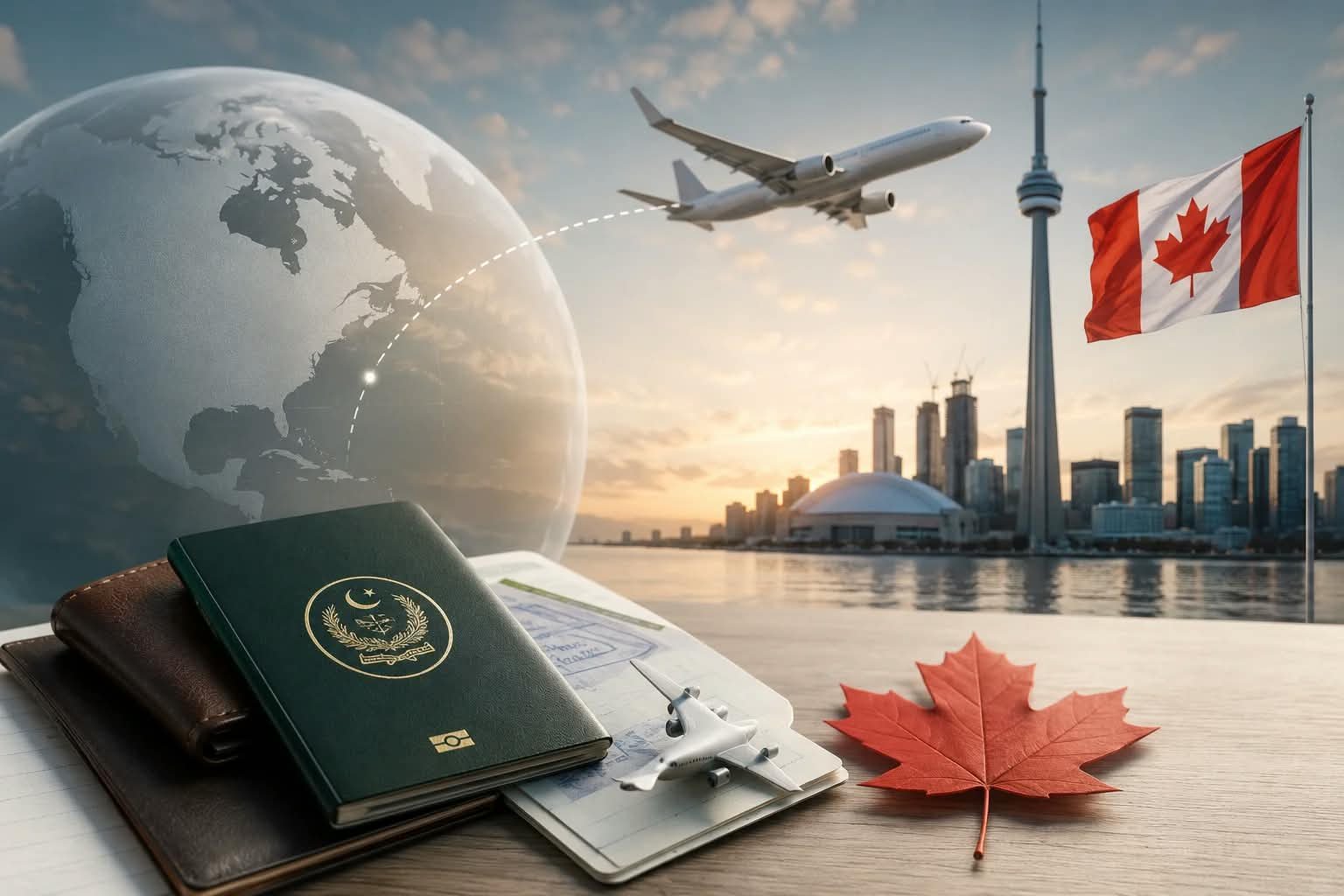
How to Prepare a Strong Canada Visitor Visa Application from Pakistan
Applying for a Canadian visitor visa requires careful planning, accurate information, and appropriate supporting documents. For applicants in Pakistan, preparing a strong application means presenting a clear explanation of the intended visit and providing evidence that supports the information entered in the application.
Canada is a popular destination for Pakistani tourists, families, and individuals attending personal or professional events. However, a visa application is not approved simply because an applicant has sufficient money or receives an invitation from someone living in Canada. Immigration officers assess the complete application against the applicable requirements.
This guide explains how to prepare a strong Canada visitor visa application, organise your supporting documents, present your financial circumstances, and avoid common mistakes.
1. Understand the Canadian Visitor Visa Requirements
Before collecting documents, familiarise yourself with the eligibility requirements for a Canadian visitor visa, also called a Temporary Resident Visa (TRV).
Applicants generally need to demonstrate that they:
-
Hold a valid travel document.
-
Have sufficient funds for the intended stay.
-
Have a genuine purpose for visiting Canada.
-
Have circumstances that support their intention to leave Canada at the end of the authorised visit.
-
Meet applicable health, security, and admissibility requirements.
The amount of money required depends on the duration of the visit, accommodation arrangements, and other expected expenses. Applicants may also need an invitation letter or additional documents, depending on their circumstances.
Read the official Canadian visitor visa eligibility requirements before preparing your application.
2. Establish a Clear Purpose for Your Visit
A strong application should explain why you intend to travel to Canada, how long you plan to stay, and what you expect to do during the visit.
A vague statement such as “I want to visit Canada” may not explain your circumstances adequately. Provide a more specific, truthful description of your intended activities.
For example, your purpose might be:
-
Visiting parents, siblings, or other relatives.
-
Spending a holiday exploring Canadian cities.
-
Attending a wedding or family celebration.
-
Visiting a friend for a specified period.
-
Attending an eligible business meeting or conference.
The supporting documents should correspond with the purpose you describe. If you plan to attend a family wedding, for example, relevant event details and a reasonable travel itinerary may help explain your proposed journey.
Do not invent an event, exaggerate a relationship, or use tourism as a false explanation for an intention to work illegally or remain in Canada permanently.
3. Prepare a Consistent Travel Itinerary
A travel itinerary helps explain the proposed dates, accommodation, and activities.
It does not have to be unnecessarily complicated. Instead, it should be realistic and consistent with your financial circumstances and stated purpose.
Consider including:
-
Proposed arrival and departure dates.
-
The cities or regions you intend to visit.
-
Accommodation arrangements.
-
Planned family visits or events.
-
An estimated budget for transport and daily expenses.
For instance, someone planning a two-week holiday could outline several days in Toronto, a visit to relatives in another city, and a return journey to Pakistan.
Avoid preparing an itinerary that conflicts with your employment leave, available funds, invitation letter, or other documents.
The Canadian government identifies travel history and itinerary information as potentially useful supporting evidence for visitor visa applications.
4. Organise Your Financial Documents Properly
Proof of funds for a Canada visa is an important part of preparing your application. You should demonstrate that your proposed trip is financially realistic and explain who will pay for it.
Depending on your circumstances, supporting evidence may include:
-
Recent bank statements.
-
Salary slips.
-
An employment letter confirming your income.
-
Business registration and financial records.
-
Evidence of savings or other accessible funds.
-
Documents from a person who will financially support your visit.
IRCC explains that bank statements can help establish whether applicants have sufficient resources. The official application guidance identifies details such as account ownership and transaction history as useful information. Check the requirements that apply to your specific application.
How much money should you show?
There is no single bank balance that guarantees approval for every applicant.
Your financial evidence should be appropriate to the length of your stay, the number of travellers, the cost of accommodation, and your expected travel expenses.
An applicant staying with relatives may have different accommodation costs from someone planning to stay in hotels throughout the trip.
A simple budget can help organise your evidence:
| Expense | Example to consider |
|---|---|
| Return airfare | Estimated return transportation cost |
| Accommodation | Hotel or other lodging expenses |
| Food | Expected meals and daily spending |
| Local transport | Public transport, taxis, or other travel |
| Activities | Tickets and sightseeing expenses |
| Emergency funds | Reasonable additional financial provision |
These categories are for planning purposes, not official minimum amounts.
Avoid unexplained bank deposits
Large deposits immediately before an application may raise questions if their source is unclear.
If a substantial deposit has a legitimate explanation, consider providing relevant supporting records. Your bank statements, declared income, and explanation should present a coherent financial picture.
Never fabricate bank statements or misrepresent another person’s money as your own savings.
5. Demonstrate Your Circumstances in Pakistan
When assessing a temporary resident application, Canadian immigration officers consider whether the applicant will leave Canada at the end of the authorised stay.
Your personal and professional circumstances can help explain your situation.
If you are employed
Relevant documents may include:
-
A letter from your employer.
-
Your position and salary details.
-
Your employment commencement date.
-
Approved leave information, where available.
-
Recent salary slips.
If you operate a business
You might provide business registration documents, relevant tax records, financial information, and evidence of ongoing business activity.
If you are a student
Enrolment confirmation, academic records, and details of your continuing studies may help explain your circumstances.
If you have family responsibilities
Relevant civil or family documents may help establish relationships and responsibilities where those details are pertinent to the application.
These documents are not guarantees of approval, and applicants do not all have identical circumstances. The objective is to provide credible evidence that supports the information in your application.
6. Write a Clear Cover Letter or Letter of Explanation
A cover letter is not a substitute for required documents, but it may help explain your circumstances and connect the evidence in your application.
A useful letter should be concise, accurate, and relevant.
Consider addressing the following points:
-
Purpose of travel: Explain why you intend to visit Canada.
-
Duration: State your proposed travel dates and expected length of stay.
-
Financial arrangements: Explain who will pay for the journey and accommodation.
-
Accommodation: Identify where you plan to stay.
-
Personal circumstances: Briefly explain relevant employment, business, family, or study commitments.
-
Supporting evidence: Identify documents that help substantiate your explanation.
Example of a visitor visa explanation
The following example is a general template. Replace the placeholders with accurate details relevant to your circumstances.
Subject: Explanation of Purpose of Visit — Canadian Visitor Visa Application
Dear Visa Officer,
I am submitting this letter in support of my application for a Canadian visitor visa. I intend to visit Canada from [proposed arrival date] to [proposed departure date] for the purpose of [state your genuine reason for travelling].
During my intended stay, I plan to [briefly describe your planned activities]. My accommodation arrangements are [explain where you will stay and whether a host is providing accommodation].
The expenses for my visit will be covered by [explain your actual financial arrangements]. I have included relevant financial and supporting documents to demonstrate the arrangements described in this letter.
My current circumstances in Pakistan include [briefly describe relevant employment, business, education, or family responsibilities]. I intend to return to Pakistan at the end of my authorised visit to continue these commitments.
I have provided the documents requested for my application and respectfully ask that my application be assessed on the information and evidence submitted.
Yours sincerely,
[Full name]
[Date]
Do not copy this template without personalising it. Remove any statement that does not accurately describe your circumstances.
7. Include an Invitation Letter When Relevant
If you are visiting a relative or friend, an invitation letter may help explain the purpose of your trip and your relationship with the host.
The letter can describe:
-
The host’s name and contact details.
-
Their status in Canada, where relevant.
-
Their relationship with the visitor.
-
The intended duration and purpose of the visit.
-
Accommodation arrangements.
-
Any financial support the host genuinely intends to provide.
Supporting evidence may include documents establishing the relationship and the host’s relevant status in Canada.
An invitation letter does not guarantee approval. Applicants must still satisfy the applicable visitor visa requirements. The official Canadian invitation letter guidance provides further information.
8. Check Your Application for Errors and Inconsistencies
One of the most practical Canada tourist visa application tips is to review every document before submission.
Check that the following details are consistent:
-
Your name and passport information.
-
Your employment history and declared income.
-
Your intended travel dates.
-
The purpose and duration of your visit.
-
Your accommodation arrangements.
-
The information in your invitation letter.
-
Your declared financial resources.
If two documents appear inconsistent, determine whether there is a genuine explanation and provide clarification where appropriate.
For example, if your employment letter states that your leave ends before your proposed return date, review the dates and correct any mistake before submitting the application.
Never alter genuine records simply to make them appear consistent. Any corrections or explanations should be truthful.
9. Follow the Official Application Process
Once your documents are ready, use the appropriate official application portal.
The usual process involves completing the required online questions, uploading the documents on your personalised checklist, paying the applicable fees, and providing biometrics if required.
The official IRCC visitor visa application guide explains the process and document requirements.
After submission:
-
Monitor your account for updates.
-
Respond to official requests within the stated deadline.
-
Keep copies of your application and supporting documents.
-
Follow the instructions for passport submission and visa issuance if approved.
Processing times vary, so consult the official processing-time tool instead of relying on unverified promises.
10. Common Mistakes That Can Weaken an Application
Even when an applicant appears to meet the basic requirements, inadequate or inconsistent evidence can create difficulties.
Avoid the following mistakes.
Using a generic purpose-of-visit letter: Explain your actual circumstances rather than relying on vague, copied statements.
Submitting irrelevant documents: More documents do not necessarily make an application stronger. Focus on evidence that supports the requirements and information in your application.
Showing funds without explaining their source: Ensure that your financial records and declared circumstances are credible.
Depending entirely on a host: A host’s support may be relevant, but the application must still address the visitor’s eligibility and circumstances.
Providing misleading information: False statements or fraudulent documents can have serious consequences.
Ignoring the refusal reasons when reapplying: If an earlier application was refused, carefully assess the concerns identified in the decision before deciding how to proceed.
Assuming an agent can guarantee approval: No representative can legitimately guarantee a favourable decision from immigration authorities.
11. Final Checklist for a Strong Canada Visitor Visa Application
Use this checklist before submitting your application.
Application preparation
0 of 10
Frequently Asked Questions
1. How can I prepare a strong Canada visitor visa application from Pakistan?
Start by reviewing the current eligibility requirements, then prepare a clear travel purpose, appropriate financial evidence, a realistic itinerary, and supporting documents relevant to your circumstances. Ensure all information is accurate and consistent.
2. What are the most important documents for a Canada visitor visa?
A valid passport and the documents specified by your application checklist are essential. Depending on your circumstances, financial records, travel information, employment evidence, an invitation letter, and relationship documents may also be relevant.
3. Does a high bank balance guarantee Canadian visitor visa approval?
No. Financial resources are only one consideration. Officers also assess the purpose of travel, the applicant’s circumstances, the intention to leave Canada, and the applicable admissibility requirements.
4. Should I include a cover letter with my visitor visa application?
A cover letter may help explain your travel purpose and supporting evidence, particularly where clarification is useful. However, it does not replace the required forms or documents, and you should follow the current application instructions.
5. Can I apply for a Canada visitor visa without an invitation letter?
Yes, an invitation letter is not required in every case. Applicants travelling for tourism or other purposes should provide the relevant evidence for their own circumstances and follow the official checklist.
6. What should I do if my Canadian visitor visa application is refused?
Read the refusal decision carefully, identify the concerns, and determine whether accurate additional evidence can address them. Consider obtaining qualified immigration advice if the issues are complex.
7. Can I use the same cover letter as another applicant?
You can use a general template as a starting point, but the final letter should accurately reflect your own travel purpose, financial arrangements, and personal circumstances. Copying another applicant’s claims may introduce inaccurate or contradictory information.
Conclusion
Preparing a strong Canada visitor visa application from Pakistan requires a coherent explanation of your travel plans, credible financial evidence, and documents that support your personal circumstances.
Rather than concentrating exclusively on the number of documents or the amount of money in a bank account, applicants should focus on the relevance, accuracy, and consistency of the information they provide.
Always consult the current Government of Canada instructions before submitting an application. Good preparation can help present your circumstances clearly, but no approach can guarantee visa approval.
Disclaimer: NewsGlobality.com is an independent informational blog. It is not affiliated with the Government of Canada and does not provide official immigration decisions or guarantees. This article is for general educational purposes and is not a substitute for professional immigration advice.